Publication Case study
Feijão Dam B-1 (Brazil, 2019)
Case study. Association of State Dam Safety Officials, Dam Failures and Lessons Learned (damfailures.org), 2025.
- Author
- Meghan Walter
- Year
- 2025
- Topics
- Failure case historiesDam safety
- Source
- See the link at the end
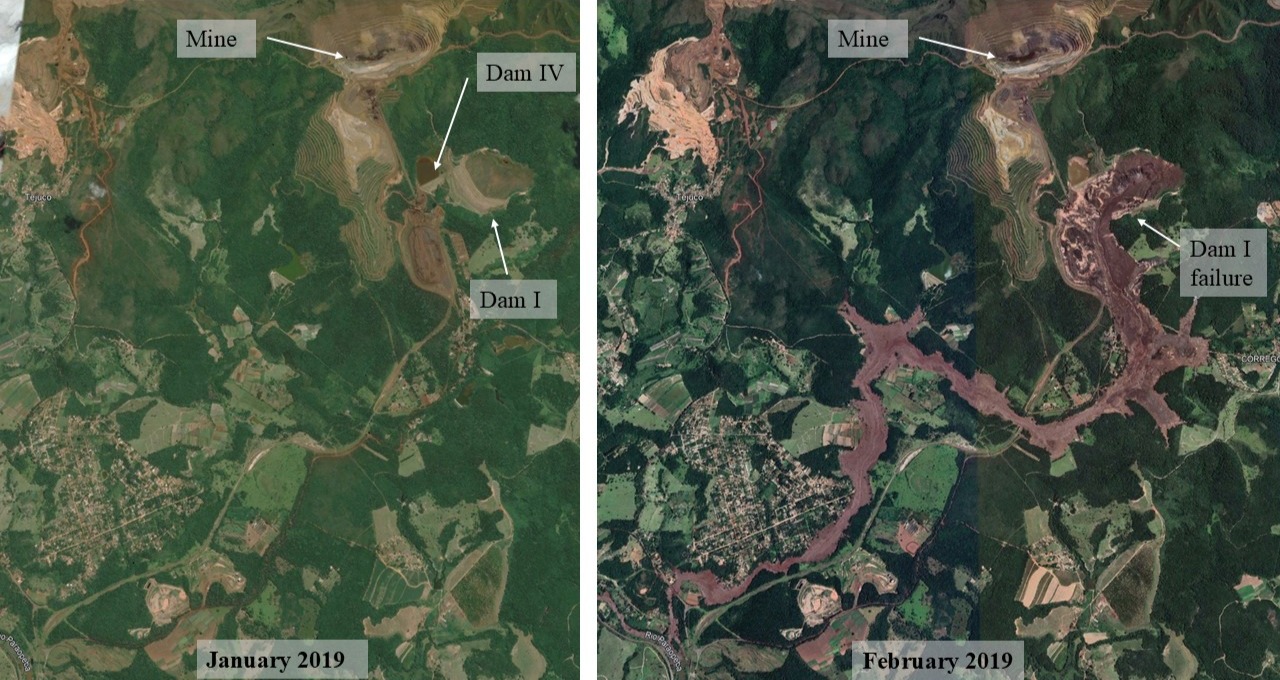
Dam B-1 was a tailings storage facility at the Córrego do Feijão iron ore mine near Brumadinho, in the state of Minas Gerais in southeastern Brazil. Ferteco owned and developed the mine and the dam until Vale S.A. acquired Ferteco in 2001. The dam stored and dewatered sluiced iron ore tailings. At 12:28 on January 25, 2019, it failed in under ten seconds, releasing 9.7 million cubic metres of liquefied tailings and killing 272 people.
| Item | Detail |
|---|---|
| Location | Brumadinho, Minas Gerais, Brazil |
| Type | Upstream-method tailings dam, iron ore |
| Height | 86 m (282 ft), crest 720 m (2,362 ft) |
| Built | 1976 to 2013, ten raisings |
| Failed | January 25, 2019, 12:28 |
| Mode | Static (flow) liquefaction |
| Released | 9.7 million m³, about 75 percent of storage |
| Fatalities | 272, of whom 258 were workers |
| Damage | About $7 billion |
Background
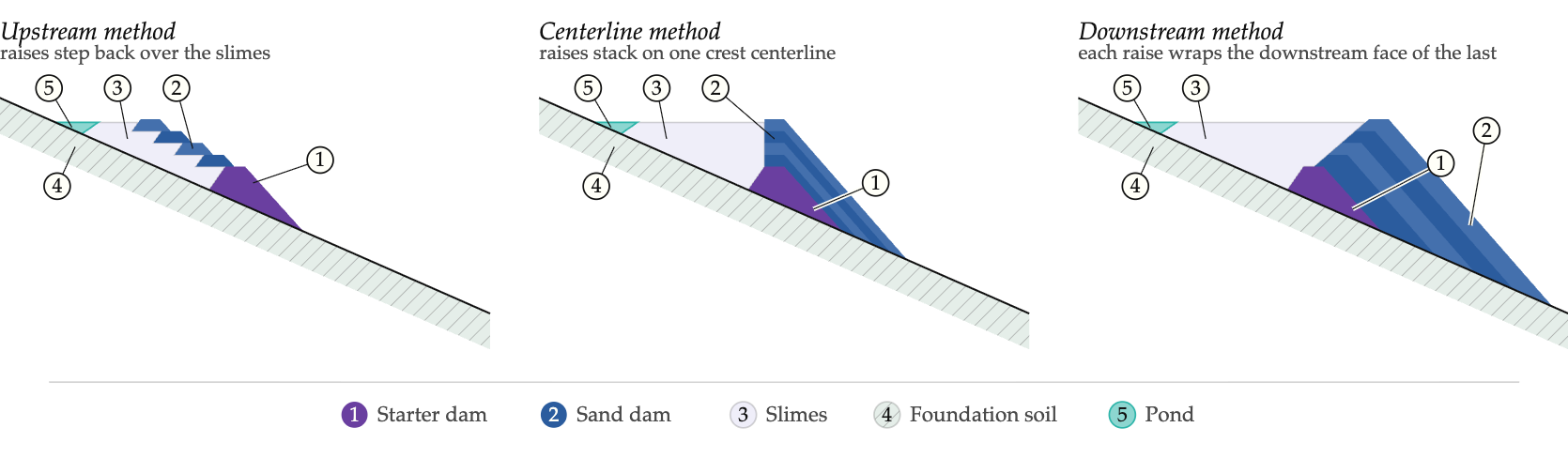
Mine tailings are the waste left after minerals are extracted and processed: a mixture of sand, silt, metals, chemicals, and water that may be solid, liquid, or a slurry of fine particles, and is often toxic or caustic. Tailings are usually discharged as a slurry to a storage facility such as a tailings dam. A tailings dam begins as a starter dike sized to hold the first two or three years of tailings plus storm storage, and is raised as the deposited tailings rise.
Dams are raised by one of three methods, named for the direction the crest moves relative to the starter dike. In the upstream method, tailings discharged from the crest form a beach, and the beach becomes the foundation for the next dike, so each raise steps back over stored tailings. In the downstream method, each raise is built on the downstream face of the embankment. In the centerline method, fill is placed on the beach and the downstream slope at once, and the crest rises vertically. The upstream method is the least costly and the least stable, and upstream dams fail more often than dams raised by the other two methods.
Construction history
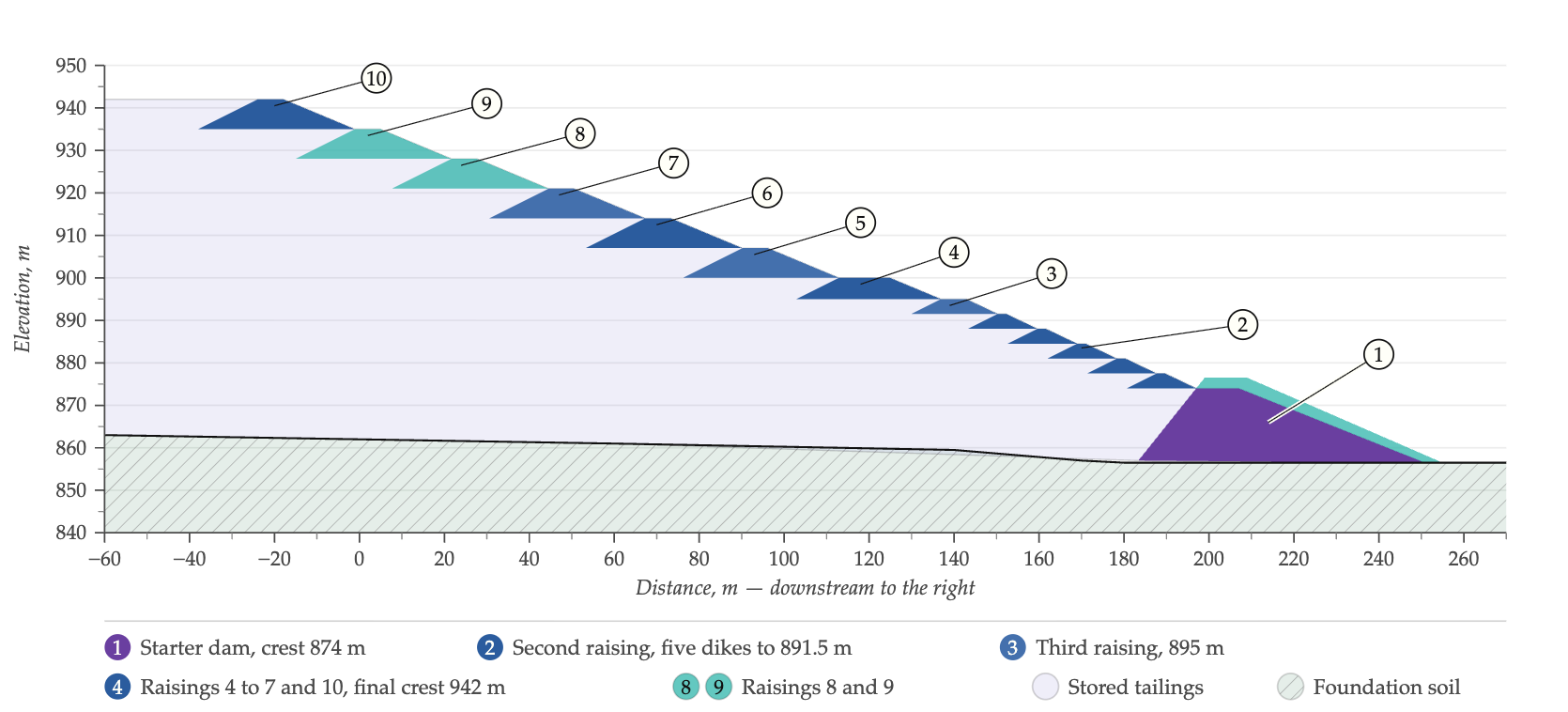
Dam B-1 was built by the upstream method over 37 years, from 1976 to 2013, in ten raisings. No raise was built after 2013, and tailings disposal ended in July 2016. The dam reached a height of 86 metres and a crest length of 720 metres. The stored tailings covered 249,500 square metres and held 12.37 million cubic metres.
| Stage | Year | Raising | Crest elevation (m) | Height (m) | Design firm | Contractor |
|---|---|---|---|---|---|---|
| 1 | 1976 | Starter dam | 874 | 18.0 | Christoph Erb | Entel |
| 2 | 1982 | Second | 877 | 21.0 | Tecnosan | Tercam |
| 3 | 1983 | Second | 879 | 23.0 | Tecnosan | Unknown |
| 4 | 1984 | Second | 884 | 28.0 | Tecnosan | Construtora Sul Minas |
| 5 | 1986 | Second | 889 | 33.0 | Tecnosan | Unknown |
| 6 | 1990 | Second | 891.5 | 35.5 | Tecnosan | Unienge Com. e Constr. Ltda. |
| 7 | 1991 | Third | 895 | 39.0 | Chammas Engenharia | Construtora Sul Minas |
| 8 | 1993 | Third | 889 | 43.0 | Chammas Engenharia | Unknown |
| 9 | 1995 | Fourth | 905 | 49.0 | Tecnosolo | CMS Constr. S.A. |
| 10 | 1998 | Fifth | 910 | 54.0 | Tecnosolo | U & M |
| 11 | 2000 | Sixth | 916.5 | 60.5 | Tecnosolo | Constr. Dragagem Paraopeba |
| 12 | 2003 | Seventh | 922.5 | 66.5 | Tecnosolo | Construtora Impar Ltda. |
| 13 | 2004 | Eighth | 929.5 | 73.5 | Tecnosolo | Integral |
| 14 | 2008 | Ninth | 937 | 81.0 | Geoconsultoria | Integral |
| 15 | 2013 | Tenth | 942 | 86.0 | Geoconsultoria | Salum Enga. |
The fill for each raise was taken from the coarse fraction of previously deposited tailings. The disposal process was meant to segregate coarse from fine material by hydraulic settling: slurry discharged from the crest onto the upstream side of the berm, with the coarse fraction settling near the berm and the fines carried farther out with the water.
The starter dam included features that impeded drainage through the toe. Later raises added no significant internal drainage beyond small drainage blankets and chimney drains in some of the upper stages. Seepage from the face above the toe was observed periodically from as early as the fourth raising. After deposition ended in 2016, piezometers showed the water level inside the dam did not drop significantly.
Between October 2018 and the failure, nine boreholes were drilled in the central and upper dam to install inclinometers and piezometers. The dam showed no distress during drilling, and no drilling-related deformation was detected. At the moment of failure, people were working on the dam and a rig was installing piezometers.
Failure
At 12:28 on January 25, 2019, Dam B-1 failed catastrophically. Video shows a slope failure developing across 80 percent of the face in about five seconds; collapse was complete in under ten. A series of retrogressive slips then worked upward through the tailings. About 9.7 million cubic metres of liquefied waste, three quarters of what was stored, released at once, engulfing the mine's railway, administration, and maintenance area, including a canteen where workers were at lunch.
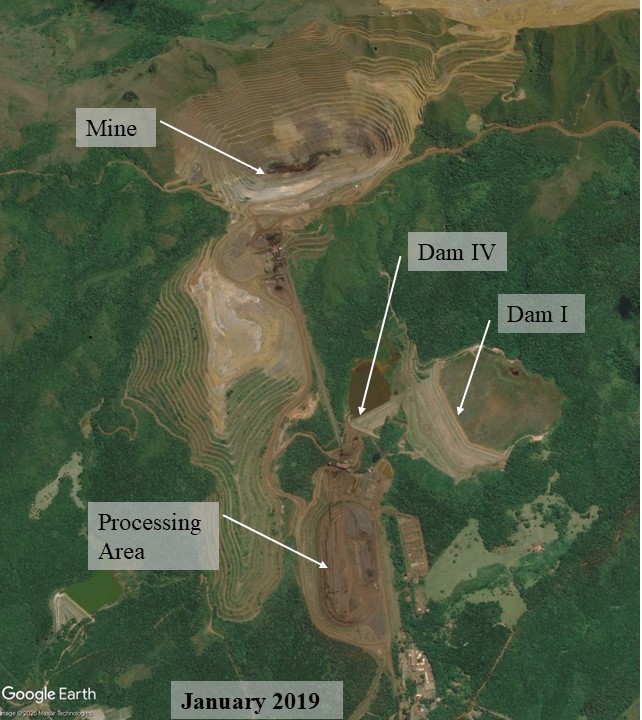
The tailings ran downstream at speeds up to 120 kilometres per hour, destroying homes, farms, and roads, covering an area the size of 450 football fields, and burying people caught in the runout. After more than eight kilometres it reached the Paraopeba River. Two hundred seventy-two people died, two of them pregnant; 258 were workers for Vale and its subcontractors, making it the deadliest workplace accident in Brazil's history. Three locomotives and 132 wagons were buried. Two sections of a railway bridge and about 100 metres of track were destroyed. The plume reached the water supply of indigenous and quilombola communities and of Brumadinho, Pará de Minas, and Belo Horizonte.
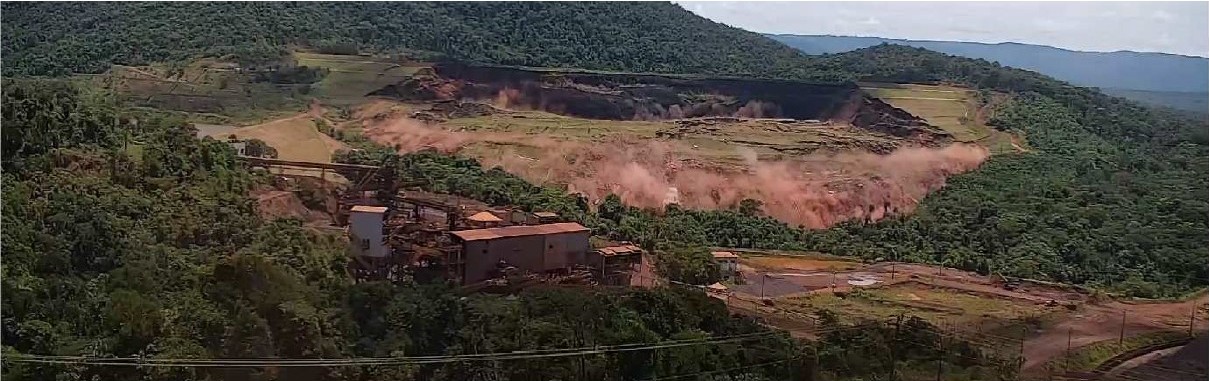
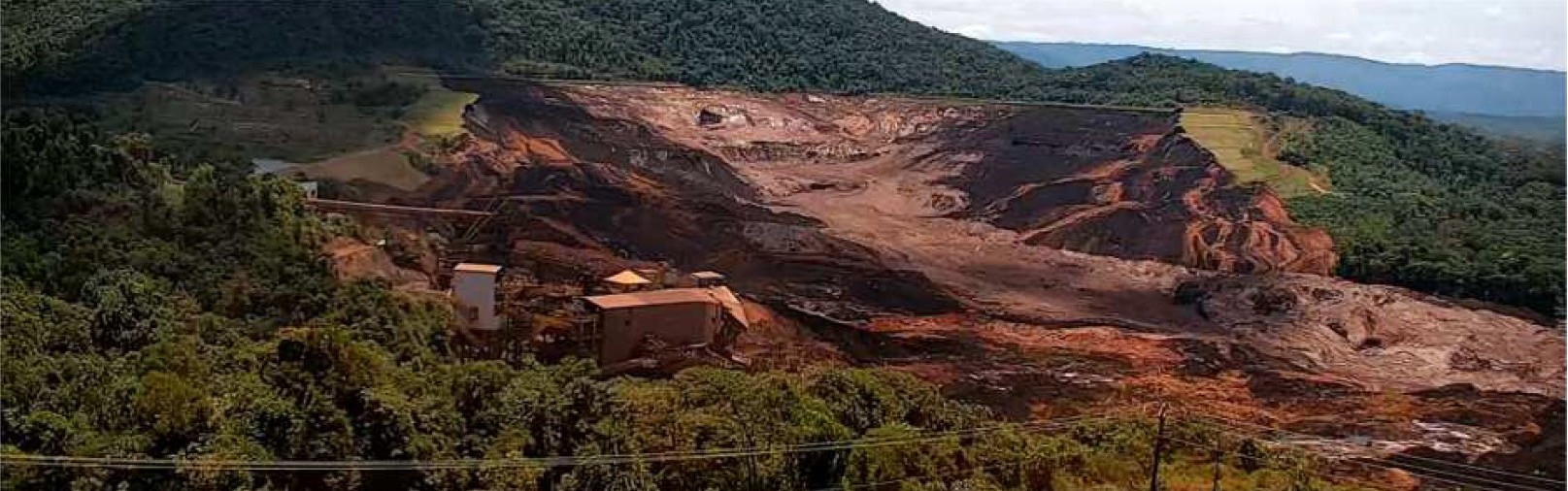
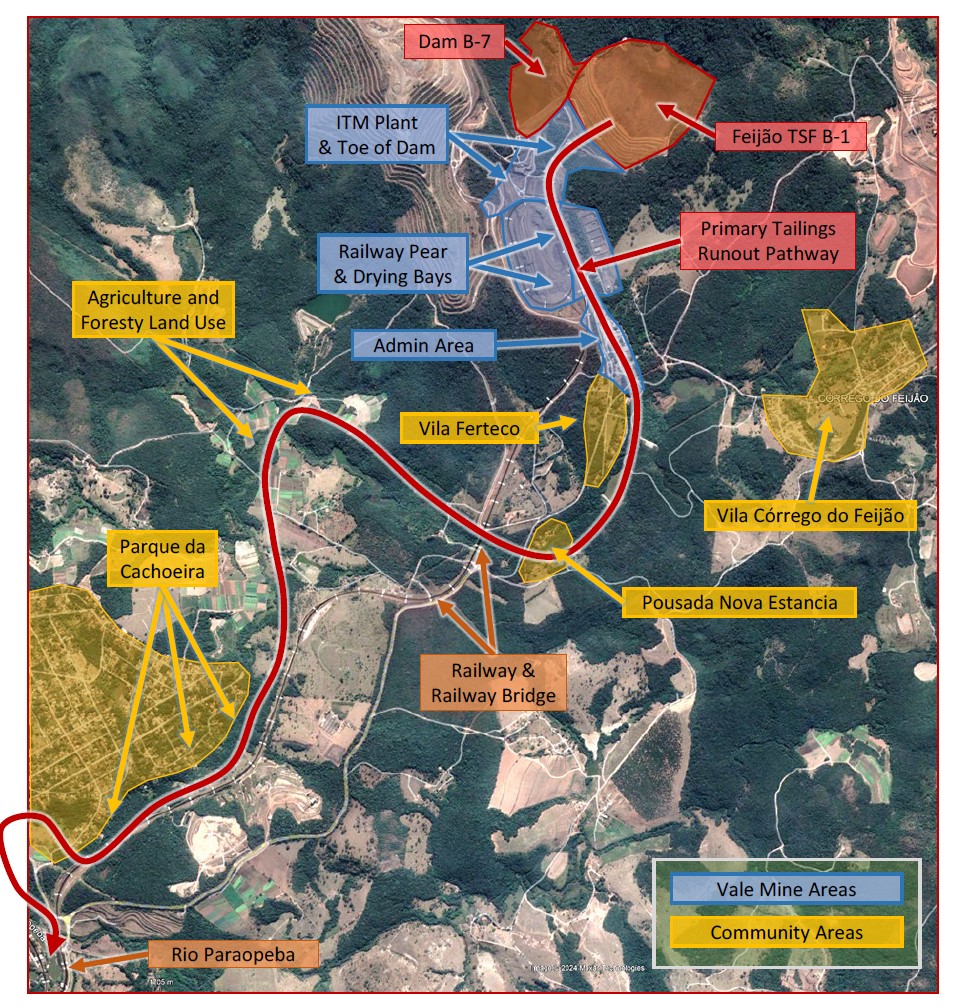
An alarm system existed to warn the population in the runout zone, but the failure was too fast for workers to identify, confirm, and sound it. Vale told the Associated Press that the area had eight sirens, but that the speed of the event made sounding an alarm impossible. The dam was extensively monitored by survey monuments along the crest, inclinometers, and piezometers, and none detected significant deformation before failure.
Firefighters from the State of Minas Gerais led the rescue with help from international teams. The mud, up to eight metres deep in places, made walking treacherous; searchers worked around its edges, crawled onto it, or were flown in by helicopter. Courts froze about $3 billion of Vale's assets for emergency services, and criminal charges followed. On January 29 authorities issued arrest warrants for five mine employees; two senior managers and another Vale employee were arrested, along with two contracted engineers who had inspected the dam.
Causes and consequences
Investigations concluded that the failure was flow, or static, liquefaction of the tailings within the dam. Video shows a relatively shallow initial failure followed by rapid shallow slips with steep back-slopes retrogressing into the impoundment. The material lost strength suddenly and became a heavy Newtonian fluid that flowed downstream at high speed.
Aerial and satellite images from before the failure show water at times close to the crest, which saturated weak tailings near the crest and interbedded layers of fine and coarse tailings within the dam. A setback in construction also placed the upper dam over weaker, fine-grained tailings.
Geotechnical investigations between 2005 and 2019 confirmed that the materials under the dam were interlayered coarse and fine tailings. Laboratory testing found them mostly loose and saturated, with a high iron content that made them heavy and stiff, and potentially very brittle if loaded undrained. Very small strains could trigger strength loss, especially in the finer layers, and the loose tailings crept, deforming slowly under constant load.
Some uncertainty remains about the trigger. No earthquake was recorded in the region that day, and although blasting occurred at nearby open pits, none was recorded on the day of the failure. The expert panel appointed by Vale1 identified five contributing conditions:
- A design that produced an overly steep upstream slope built over weaker fine tailings.
- A lack of internal drainage, which kept the water level in the dam high.
- Water management that allowed the pond close to the crest.
- Seasonal heavy rainfall, which produced a small loss of strength in the unsaturated material above the water level.
- High iron content, which made the tailings heavy and bonded particles together.
These conditions left a marginally stable dam close to failure under undrained loading. The panel concluded that the failure came from a critical combination of ongoing internal strain from creep and a loss of strength as the unsaturated zone lost suction during the intense rainfall of late 2018. A second panel appointed by the Federal Public Prosecutor's Office2 concluded in 2021 that the tailings were not bonded, and that the drilling of a borehole was a possible trigger.
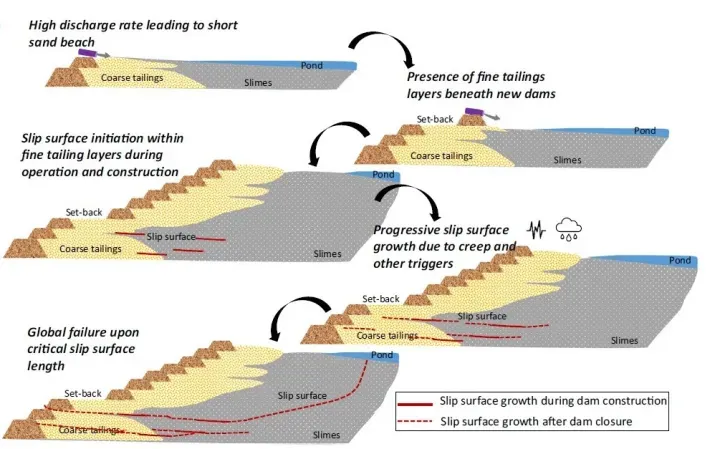
A 2024 study by Zhu, Zhang, and Puzrin3 proposes a third mechanism: delayed growth of slip surfaces along the weak fine layers, driven by creep. The fine layers gave slip surfaces a place to start and to propagate under the increasing weight of the dam during construction. Their length was not enough to fail the dam while it was being raised. After closure in 2016 the load stopped growing, but the surfaces kept lengthening under constant load, slowly and unstably, until they reached a critical length and the classical catastrophic propagation followed.
Vale reached an agreement with the state and federal attorneys general, public prosecutors, and public defenders to make monthly emergency payments to affected people through October 2021, and later agreed to about $7 billion in compensation. The company is legally required to eliminate its upstream-raised tailings storage facilities and aims to decommission all of them by 2035. It adopted the Global Industry Standard on Tailings Management after the disaster.
Lessons learned
- Regular operation, maintenance, and inspection of dams is important to the early detection and prevention of dam failure.
- Static liquefaction should be considered as a potential failure mode for dams that have loose sands or silts in their embankments or foundations.
- Timely warning and rapid public response are critical to saving lives during a dam emergency.
- Tailings dams raised by the upstream method are more susceptible to liquefaction, especially when the tailings behind them are saturated.
- A tailings dam is under construction until it is closed, and needs continuing evaluation as conditions change.
Further viewing
- Expert Panel technical report and video, Robertson and others, 2019.
- Intro to Tailings Dam and Coal Ash Impoundment Design, Construction and Monitoring, an ASDSO on-demand webinar.
References
- Robertson, P.K., de Melo, L., Williams, D.J., and Wilson, G.W. (2019). Report of the Expert Panel on the Technical Causes of the Failure of Feijão Dam I.
- Arroyo, M., and Gens, A. (2021). Computational Analyses of Dam I Failure at the Córrego de Feijão Mine in Brumadinho. Final report for Vale S.A., August 2021.
- Zhu, F., Zhang, W., and Puzrin, A.M. (2024). The slip surface mechanism of delayed failure of the Brumadinho tailings dam in 2019. Communications Earth and Environment, 5(33).
- Silva Rotta, L.H., and others (2020). The 2019 Brumadinho tailings dam collapse: possible cause and impacts of the worst human and environmental disaster in Brazil. International Journal of Applied Earth Observation and Geoinformation, 90, 102119.
- Johnstone, W., and Morrill-Winter, J. (2024). Application of USACE LifeSim to the Feijão Dam B-1 tailings storage facility failure of January 25, 2019. Proceedings of Tailings and Mine Waste 2024. Colorado State University.
- Silva de Sousa, M., and Prengaman, P. (2019, January 28). Death toll from Brazil dam collapse rises to 58. Associated Press.
- Vale dam disaster: $7bn compensation for disaster victims. (2021, February 4). BBC.
- Brumadinho. (n.d.). Vale.
- Troncoso, J.H., Verdugo, R., and Valenzuela, L. (2017). Seismic performance of tailings sand dams in Chile. Proceedings of the 16th World Conference on Earthquake Engineering.
This case study was written for the Association of State Dam Safety Officials and peer reviewed by William Johnstone, Ph.D., P.E., Spatial Vision Consulting Ltd., and John W. France, P.E., JWF Consulting LLC.