Publication Case study
Barahona No. 1 Dam (Chile, 1928)
Case study. Association of State Dam Safety Officials, Dam Failures and Lessons Learned (damfailures.org).
- Author
- Meghan Walter
- Year
- 2024
- Topics
- Failure case historiesDam safety
- Source
- See the link at the end
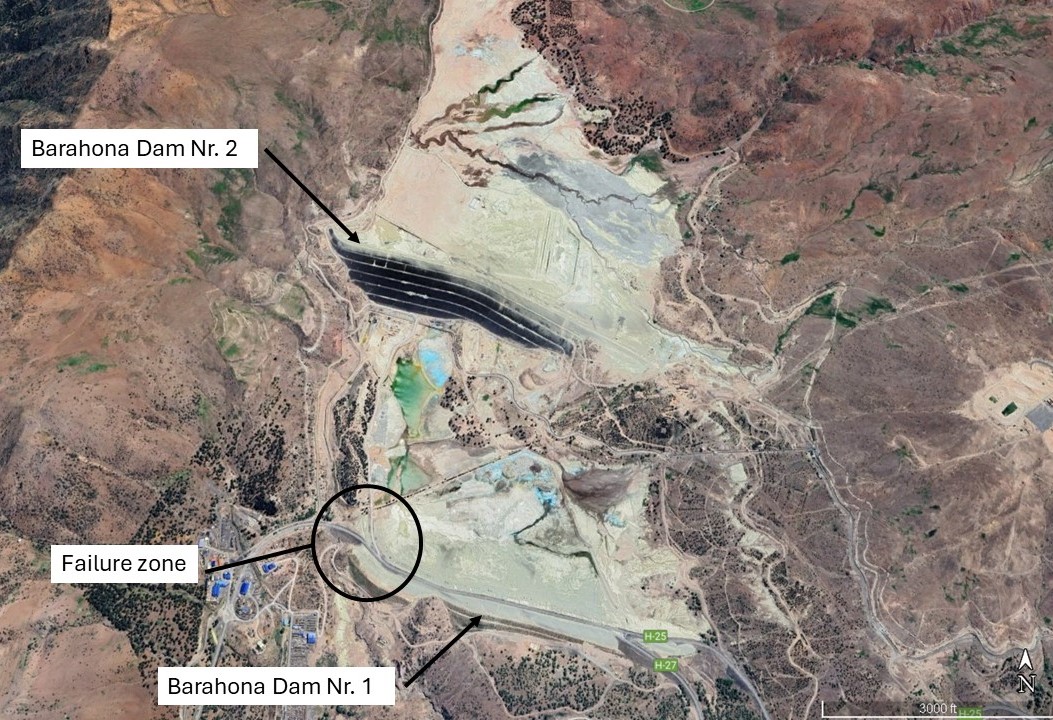
Barahona No. 1 stored copper tailings from the El Teniente mine in a steep Andean canyon above Santiago, Chile. Begun in 1917 as a clay earthfill dam, it was redesigned after two costly years and raised by the upstream method from 1920. On December 1, 1928, a magnitude 8.2 to 8.4 earthquake shook it for a minute and forty seconds. The dam stood through the shaking and collapsed two or three minutes after it stopped. Four million tonnes of tailings ran down the canyon and killed 54 people. It is the first recorded earthquake-induced failure of a tailings dam in Chile, and one of the clearest early records of liquefaction after shaking ends.
| Item | Detail |
|---|---|
| Location | El Teniente mine, near Santiago, Chile |
| Type | Upstream-method tailings dam of coarse tailings sand, copper |
| Height | 65 m (213 ft); crest 1,885 m long; 2H:1V downstream slope |
| Built | Foundation 1917; clay dam abandoned at 7 m; tailings deposition from March 1920 |
| Failed | December 1, 1928, two to three minutes after the Talca earthquake |
| Mode | Seismically induced flow liquefaction |
| Released | 4 million tonnes of tailings from a 400 m breach; waves reported over 60 m |
| Stored | 27 million tonnes at the time |
| Fatalities | 54 |
Background
Copper tailings are a slurry of ground rock, water, and the chemical reagents of the metallurgical process. The original design for El Teniente's storage dam called for a 78 metre earthfill dam of imported clay, raised in stages to keep ahead of the tailings. Foundation work began in 1917. Earth arrived by train, moved to the site in horse carts, and was compacted with steam rollers. After two years the project stopped on cost and difficulty, with the dam seven metres high.
Tailings dams are raised by one of three methods, named for the direction the crest moves relative to the starter dike. In the upstream method, tailings discharged from the crest form a beach upstream, and the beach becomes the foundation for the next dike. In the downstream method, fill is placed on the downstream side. In the centerline method, fill goes on the beach and the downstream slope at once. After the difficulties of the clay dam, the design was changed: a new starter dam was built downstream of the original, deposition began in March 1920, and the dam was raised by the upstream method.
Failure
When the Talca earthquake struck central Chile on December 1, 1928, Barahona No. 1 was 65 metres high and 1,885 metres long, with a two-to-one downstream slope, and held 27 million tonnes of tailings. The epicenter was a little over 100 miles away. The dam survived the shaking, which lasted about one minute forty seconds, and then failed catastrophically. A construction engineer watched from his house about 1,000 feet away and put the collapse two or three minutes after the shaking ended.
The cause was seismically induced flow liquefaction: the cyclic accelerations liquefied the deposited tailings, the shear strength fell, the sand embankments displaced, and the upper dikes near the left abutment settled. A 400 metre section near the maximum section of the dam gave way. Four million tonnes of tailings ran down the canyon in waves reported at more than 60 metres. Fifty-four people died, and bridges, a railroad, and crops were destroyed.
The failed section was repaired and the dam was filled to a final level 17 metres below the original crest. A second dam, Barahona No. 2, was begun upstream in 1929 by the downstream method and operated until 1936. Both dams came through earthquakes of similar magnitude in 1985, 2010, and 2015 without incident.
Causes
In 1991 Jorge Troncoso, professor of geotechnical engineering at the Catholic University of Chile, investigated the site with piezocone and standard penetration tests. Upstream construction had interbedded tailings and sands. The dike sands had about 20 percent fines; the tailings in the pond had 83 to 92 percent. The soils in the dam were not consolidated when the earthquake struck. Cyclic loading raised pore-water pressures until strains reached the critical steady state of minimum shear strength. The tailings in the impoundment liquefied and threw more shear stress onto the retaining dikes. As driving stress rose and strength fell to residual values, the factor of safety dropped below one, large displacements followed, and the dam failed. The decision to abandon the clay dam for upstream raising with tailings mattered, because part of the dam then rested on soft silts that generated high pore pressures under undrained loading.
Soil mechanics was young. Terzaghi's Erdbaumechanik had appeared in 1924; Casagrande would propose the critical void ratio in 1935. The original drawings and reports show an understanding of the basics, including classification and segregation of materials and compaction. Raising the dam by the upstream method above a populated valley was a high-risk choice, but a common one, and the practice continues, less often, today. The method is the least stable because the walls rise on a base of unconsolidated slurry, excess pore pressures build as the dam is raised, and high pore pressures raise the risk of liquefaction.
The failure brought no change to tailings practice or regulation in Chile. That waited for the El Cobre failures of 1965, which killed more than 200 people by the same mechanism. Chilean practice then moved away from the upstream method and flattened downstream slopes, and regulation followed. Val di Stava in 1985 and Merriespruit in 1994 went on demonstrating the risk elsewhere.
Lessons learned
- Dams located in seismic areas should be evaluated for liquefaction, cracking, potential fault offsets, deformations, and settlement due to seismic loading.
- Regular operation, maintenance, and inspection of dams is important to the early detection and prevention of dam failure.
- Timely warning and rapid public response are critical to saving lives during a dam emergency.
- A tailings dam is under construction until it is closed, and needs continuing evaluation as conditions change.
- A strong quality and risk management system should cover every phase of a tailings facility, including closure.
Further viewing
- Intro to Tailings Dam and Coal Ash Impoundment Design, Construction and Monitoring, an ASDSO on-demand webinar.
- The El Teniente tailings dam failure, 1928, Stava 1985 Foundation.
References
- Cacciuttolo, C., and Atencio, E. (2022). Past, present, and future of copper mine tailings governance in Chile (1905 to 2022). International Journal of Environmental Research and Public Health, 19(20), 13060.
- Troncoso, J.H., Verdugo, R., and Valenzuela, L. (2017). Seismic performance of tailings sand dams in Chile. Proceedings of the 16th World Conference on Earthquake Engineering.
- Troncoso, J.H., Vergara, A., and Avendaño, A. (1993). Seismic failure of Barahona tailings dam. International Conference on Case Histories in Geotechnical Engineering, 34.
- Verdugo, R. (2023). Static liquefaction in the context of steady state/critical state and its application in the stability of tailings dams. Soil Dynamics and Earthquake Engineering, 176.
- Villavicencio, G., Espinace, R., Palma, J., Fourie, A., and Valenzuela, P. (2014). Failures of sand tailings dams in a highly seismic country. Canadian Geotechnical Journal, 51(4), 449 to 464.
- Williams, D.J. (2021). Lessons from tailings dam failures: where to go from here? Minerals, 11(8), 853.
- The Stava 1985 Foundation. (n.d.). The El Teniente tailings dam failure, 1928.
This case study was written for the Association of State Dam Safety Officials and peer reviewed by John France, P.E., JWF Consulting.