Publication Case study
Val di Stava Dam (Italy, 1985)
Case study. Association of State Dam Safety Officials, Dam Failures and Lessons Learned (damfailures.org).
- Author
- Meghan Walter
- Year
- 2024
- Topics
- Failure case historiesDam safetyEngineering ethics
- Source
- See the link at the end
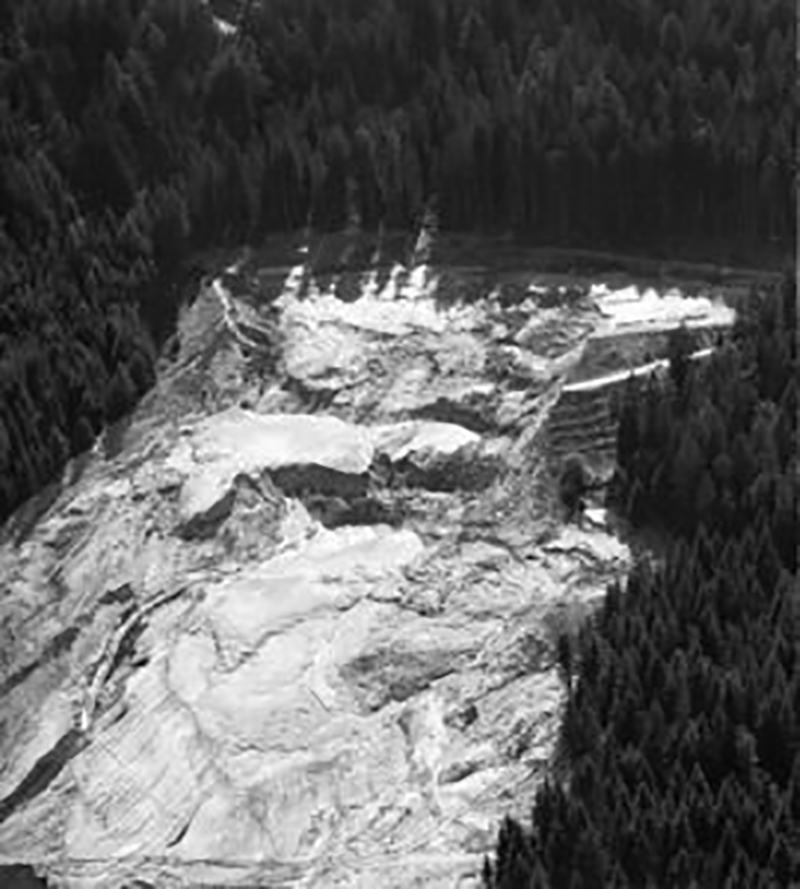
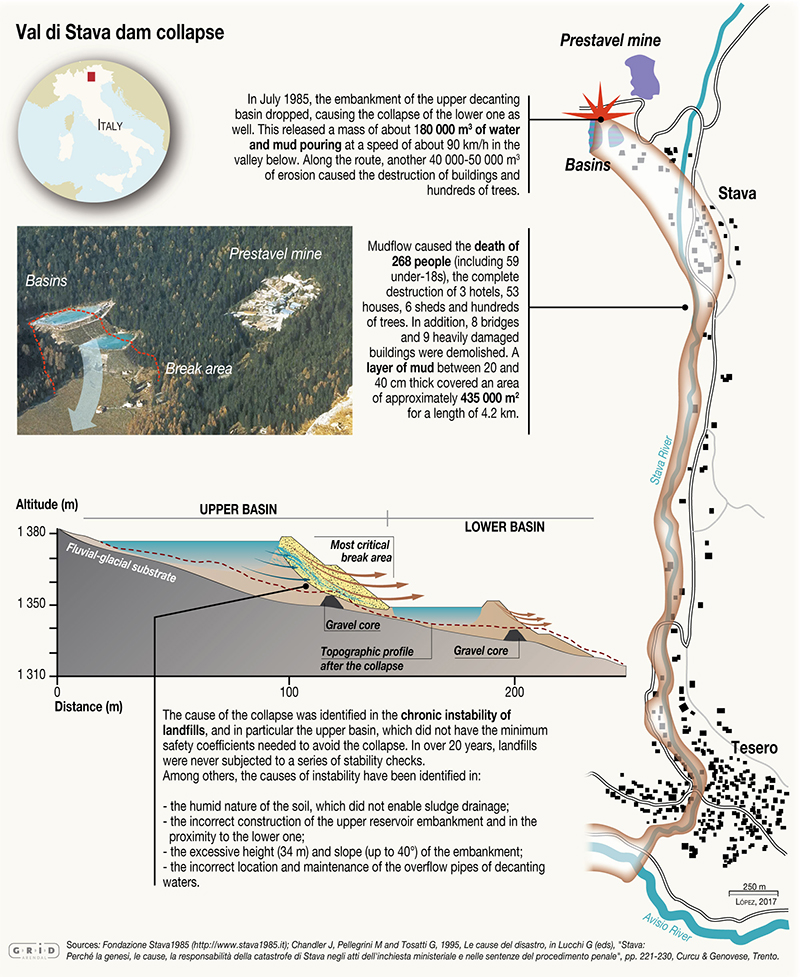
Two tailings basins in series stored fluorite processing waste above the village of Stava in the Italian Alps. The lower embankment dated from 1961; the upper, added from 1969, came to rest on the silt of the lower basin. Neither was ever inspected by a regulator. Shortly after noon on July 19, 1985, the upper dam failed onto the lower one, and a flow of sand, silt, and water ran 4.2 kilometres down the valley at about 90 kilometres an hour. It killed 268 people. A court later found the plant had been designed, built, and managed without the safety margins society expects from works that can end whole communities.
| Item | Detail |
|---|---|
| Location | Val di Stava, Tesero, Province of Trento, Italy |
| Type | Two tailings dams in series; lower raised upstream, upper begun centerline then upstream; fluorite |
| Height | Lower 25 m, upper 34 m; nearly 60 m (197 ft) combined |
| Built | Lower 1961; upper from 1969 |
| Failed | July 19, 1985, shortly after noon |
| Mode | Local slope failure of the upper downstream face from a rising phreatic surface, then liquefaction |
| Released | About 180,000 m³ of tailings, of 300,000 m³ stored |
| Fatalities | 268 |
| Damage | 3 hotels, 53 houses, 6 warehouses, 8 bridges; €133 to 150 million |
Background
Mining around Mount Prestavèl in northeastern Italy goes back to the sixteenth century and argentiferous galena, a sulfide of lead and silver. By 1934 the focus had shifted to fluorite. In 1961 the operator replaced gravimetric separation with froth flotation and built a new plant. Flotation needed far more water and produced wastewater and sludge, and an embankment dam was built that year as a settling basin to hold and decant it.
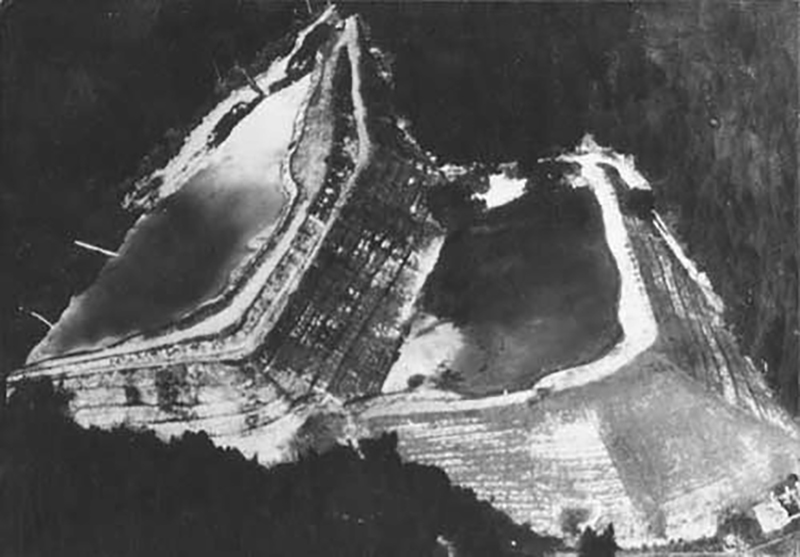
The base embankment was raised in the upstream direction as tailings were placed above it, fed by a pipeline about 400 metres long. By 1969 it stood over 25 metres. To expand capacity, a second dam and basin were begun upstream in 1969, arranged in series so the upper basin decanted into the lower.
Tailings dams begin as a starter dike sized for the first two or three years plus flood storage and are raised as the tailings rise, by one of three methods named for the direction the crest moves. In the upstream method, tailings discharged around the crest form a beach that becomes the foundation for the next dike. In the downstream method, fill goes on the downstream slope. In the centerline method, fill goes on the beach, the crest, and the downstream slope together.
The upper dam was first raised by the centerline method, but as it grew it also widened toward the valley and came to rest on the silt of the lower basin, and construction shifted to the upstream method.
Warnings
After their original construction the embankments were never inspected by regulators, and stability checks were minimal even as they were raised. In 1974 the municipality of Tesero asked for confirmation that the dams were safe. The check that followed found the downstream slope of the upper dam very steep, at 39 degrees, and its stability marginal. Nothing was done. The basins were not raised between 1978 and 1982; use of the upper dam resumed in 1983 and continued to the failure.
| When | What happened |
|---|---|
| 1961 | Lower dam built as a settling basin for the new flotation plant |
| 1969 | Upper dam and basin begun, first by the centerline method, later upstream, its toe on the lower basin's silt |
| 1974 | Tesero asks for a safety confirmation; check finds the upper slope at 39° and marginally stable; no action |
| 1978 to 1982 | Basins not raised |
| 1983 | Upper dam back in use |
| Jan 1985 | Sinkhole at the toe of the right bank of the upper basin from a failed drain; water and sand leak from the lower toe; debris flow of 200 m |
| Jun 1985 | Drain ruptures in the left bank of the lower basin; sinkhole 3 m deep |
| Jul 19, 1985 | Upper dam collapses onto the lower shortly after noon |
Failure
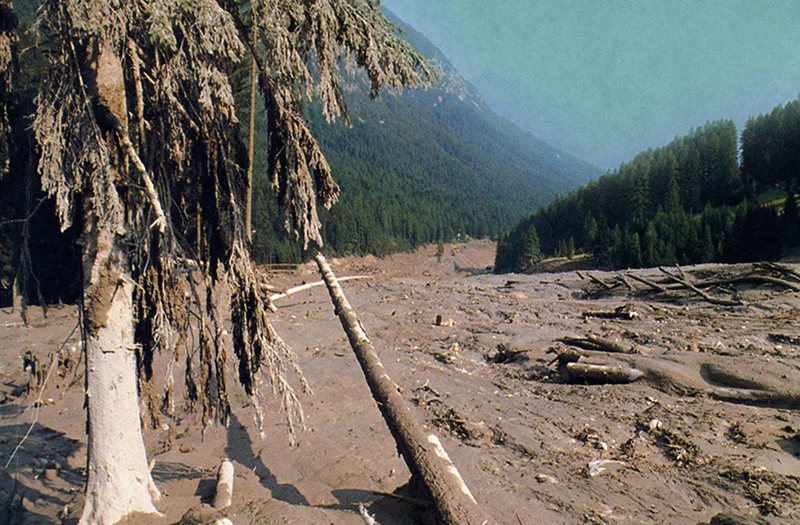
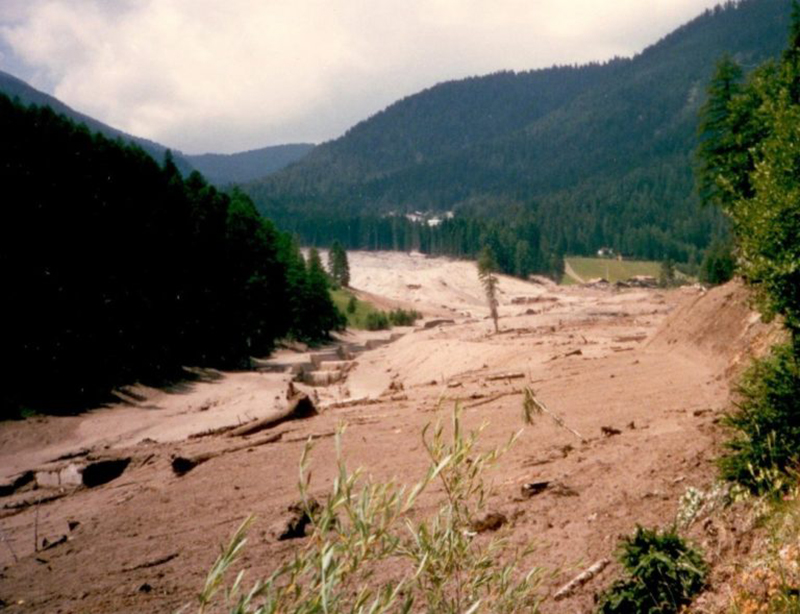
Shortly after 12 p.m. on July 19, 1985, the upper embankment collapsed suddenly onto the lower, which then failed. The mudflow ran down the valley at about 90 kilometres an hour, sweeping away everything in its path until it reached the Avisio River 4.2 kilometres below. It killed 268 people and destroyed three hotels, 53 houses, six warehouses, and eight bridges. Damage was put at more than €133 million. At the time the lower dam was 25 metres high and the upper over 34, nearly 60 metres of storage in all, holding 300,000 cubic metres; about 180,000 went down the valley.
Causes and consequences
Physical and human factors combined. Both dams were built of heterogeneous, liquefiable material, and the toe of the upper dam sat on the tailings of the lower basin. The design engineer and the laborers who built the upper basin said the ground was known to be swampy, with many springs; the lower basin was similar. The mine assumed deposited tailings would dewater quickly. They did not, which left the tailings saturated and the phreatic surface in the embankments high. The drainage pipes of the upper basin were laid badly and sagged under the deposited material, then leaked. In the months before the collapse two sinkholes opened from failing drains, one in January 1985 at the toe of the right bank of the upper basin, when landowners below saw water and sand leaking from the lower toe and a debris flow ran 200 metres downstream, and one in June in the left bank of the lower basin, three metres deep, from a ruptured pipe. There was no permanent instrumentation to monitor stability or drainage.
The plant collapsed essentially because it was designed, built and managed in such a way as not to offer those safety margins that civil society expects from works that can jeopardize the existence of entire human communities. The upper embankment in particular was poorly founded, poorly drained, statically at the limit. It could only collapse at the slightest modification of its precarious conditions of equilibrium.
So found the ministerial commission of inquiry convened by the Court of Trento. Investigators concluded that a local slope failure on the downstream face of the upper embankment, caused by a rising phreatic surface, set off liquefaction of the sandy and silty soils. The collapsed length of the upper dam was about 100 metres, and its downstream movement brought down the lower embankment.
In June 1992 ten people were convicted of culpable disaster and multiple manslaughter: the mine directors responsible for operating and maintaining the embankments, managers of the companies involved in decisions about the upper basin from 1969 to 1985, and the managers of the provincial mining district who had omitted every check. The prison terms were reduced and none was served; the convicted paid damages as those civilly responsible for their employees' fault.
Families of the victims and the community formed the Stava 1985 Foundation to keep the memory of the catastrophe alive and to strengthen the culture of prevention, sound management, and structural safety. Thousands visit its information center. The foundation helped create a master's program in the analysis and management of geotechnical systems at the University of Trento, spanning civil and environmental engineering, geology, sociology, and economics.
Lessons learned
- Dam failure sites offer an important opportunity for education and memorialization.
- Dams should be thoroughly assessed for risk using a periodic risk review process.
- Earth and rockfill embankment dams must be stable under the full range of anticipated loading conditions.
- Regular operation, maintenance, and inspection of dams is important to the early detection and prevention of dam failure.
- Stability of the dam foundation and other geologic features must be considered during dam design.
- Tailings dams raised by the upstream method are more susceptible to liquefaction, especially when the tailings behind them are saturated.
- Static liquefaction can cause failure of embankment dams.
Further viewing
- The collapse, Stava 1985 Foundation.
- Intro to Tailings Dam and Coal Ash Impoundment Design, Construction and Monitoring, an ASDSO on-demand webinar.
References
- Luino, F., and De Graff, J.V. (2012). The Stava mudflow of 19 July 1985 (Northern Italy): a disaster that effective regulation might have prevented. Natural Hazards and Earth System Sciences, 12(4).
- Pirulli, M., Barbero, M., Marchelli, M., and Scavia, C. (2017). The failure of Stava Valley tailings dams (Northern Italy): numerical analysis of the flow dynamics and rheological properties. Geoenvironmental Disasters, 4(3).
- Simeoni, L., Tosatti, G., Lucchi, G., and Longo, M. (2017). The Stava catastrophic failure of July 19, 1985 (Italy): technical-scientific data and socioeconomic aspects. City Safety Energy Journal.
- Stava 1985 Foundation. (2020). Val di Stava failure.
- Vick, S.G. (1990). Planning, Design, and Analysis of Tailings Dams. BiTech Publishers.
This case study was written for the Association of State Dam Safety Officials and peer reviewed by Mike Hand, P.E., John Batka, P.E., Colorado Division of Water Resources, and Charles Cobb, P.E., Alaska Department of Natural Resources.